Showing posts with label news. Show all posts

Thursday, 12 November 2020

New on SI: Best Defensive Players in Cleveland Browns History

A quick scan of Hall of Famers who played for the Browns shows a lot of offensive talent, but the franchise has employed some true defensive standouts over the years. This article will count down the top 10 defensive players in the history of the Browns.
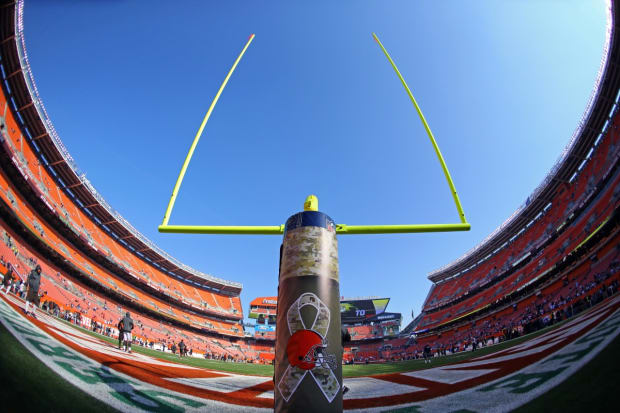
FirstEnergy Stadium is shown during a military appreciation game in 2016. The Browns defense is tasked with protecting the field eight times per season.

Who Are the Browns' Greatest Defensive Players of All Time?

The vast majority of players to represent the Browns in the Pro Football Hall of Fame played on the offensive side of the ball, but that doesn't mean the franchise hasn't seen its fair share of talented defenders. Only two defensive players who spent the majority of their careers with Cleveland have ended up enshrined in Canton, but along the way, the Browns have rostered a plethora of other standout defensive stars.

Defensive strength began in Cleveland's earliest days, as Hall of Fame coach Paul Brown brought on a multitude of stars that helped his team dominate the short-lived All-America Football Conference from 1946 to '49. More talent would join during the 1950s after the Browns merged into the NFL and started a dynasty.

Throughout the 1960s and early '70s, the defense would continue to help the Browns stay relevant, and in the late '80s, a big group of star defenders banded together for a five-year stretch of success. Cleveland's defense hasn't been as potent since the 1990s, but the team hopes to find defensive firepower again sooner than later.

Selection Criteria for This List

This list of the 10 greatest Browns defensive players of all-time also includes a handful of honorable-mention candidates and the franchise's defensive records. The criteria used to develop this list include:

  • Legacy Honors (Hall of Fame, Ring of Honor, retired number, etc.)
  • Single-Season Honors (MVP, first-team All-Pro, Pro Bowl, etc.)
  • On-Field Success (league leader, playoff appearances, records, etc.)
  • Longevity (years with Browns, percentage of career with Browns, etc.)

Only games played with the Browns are factored into this list, so while Hall of Fame defensive lineman Willie Davis would be a great player to include on a list about the Packers, his eight starts in two seasons with the Browns won't make the cut here.

10. Jim Houston

  • Seasons With Browns: 1960–72
  • Position: Linebacker
  • Playoff Appearances: 1964–65, 1967–69, 1971–72
  • Pro Bowl: 1964–65, 1969–70

It's likely the Browns were already pretty familiar with Jim Houston's talent before drafting him in the first round of the 1960 NFL Draft. His older brother, Lin, had played on the offensive line for Cleveland and coach Paul Brown from 1946 to '53, so he surely put in a good word for Jim—who was busy winning championships at Massillon Washington High School and Ohio State University. Houston would later achieve the trifecta of championships by helping the Browns claim the 1964 NFL title.

Dependable, fast, and strong, Houston started his career as a defensive end, but moved to outside linebacker after Brown was replaced as head coach before the 1963 season.

Houston missed just three games throughout his 13 years in action, and Cleveland never had a losing season during his career. He intercepted 14 passes—including three he ran back for touchdowns—and he added one interception in the postseason, snatching a pass in 1969 against the Cowboys.

One of Houston's finest efforts, however, doesn't show up directly in the game statistics. The Browns were heavy underdogs in the 1964 NFL championship game against the Colts, but with the help of strong defense, Cleveland came away a 27–0 winner. Houston was assigned to help defend future Hall of Fame tight end John Mackey who gained just two yards in the game.

9. Warren Lahr

  • Seasons With Browns: 1949–59
  • Position: Defensive back
  • Playoff Appearances: 1949–55, 1957–58
  • Pro Bowl: 1953

The Browns and Steelers weren't yet rivals, but if they had been, Warren Lahr would have had his own short chapter in the story of the rivalry. Lahr was drafted by Pittsburgh in the last round of the 1947 draft, but suffered a major knee injury and was released. The Browns promptly signed him, let him recover throughout the 1948 season, and slotted him into the starting lineup in '50. An 11-year tenure of greatness was born, and it saw Lahr help the Browns to four championships.

As a rookie, he made several key interceptions down the stretch of the regular season and was a big factor in a 21–7 victory over the 49ers in the final AAFC title game. Intercepting passes was a huge part of the lore of Lahr, whose 44 career interceptions stood as a franchise record until the 1980s.

Lahr had at least one interception each season he played, and had at least five in every campaign from 1950 to '55. In 1950 and '51, he returned two interceptions for touchdowns to lead the NFL in both seasons. Also in '50, Lahr had an interception in a one-game tie-breaker against the Giants that determined which team would represent the American Conference in the NFL title game. Cleveland won 8–3, and Lahr added two interceptions in the following week's title game, a 30–28 win over the Rams.

8. Michael Dean Perry

  • Seasons With Browns: 1988–94
  • Position: Defensive lineman
  • Playoff Appearances: 1988–89, '94
  • All-Pro: 1989–90
  • Pro Bowl: 1989–91, 1993–94
  • Awards: AFC Defensive Player of the Year (1989)

It's not often that a player drafted 50th overall rises to the ranks of Defensive Player of the Year by his second season, but Michael Dean Perry was a textbook example of what an overlooked player looks like.

Quick and nimble, but also mammoth, Perry weighed in around 285 pounds and was among the NFL's top defensive lineman for the duration of his seven-year career in Cleveland. His agility allowed him to overcome double-teams and record at least four sacks in each of his first six seasons, and he brought down a quarterback 51.5 times with the Browns—easily the most among Cleveland defensive lineman since sacks became an official statistic in 1982.

As a rookie, Perry scored the only touchdown of his career in a must-win matchup to end the season, when he recovered a fumble and ran 10 yards to help the Browns secure a playoff spot with a 28–23 victory over the Oilers. Perry would help lead the Browns into the postseason again in 1989, but the team would struggle over the next several seasons, even though Perry remained a star.

In 1994, Perry posted below-average numbers, but the team's defense allowed just 12.8 points per game and went back to the playoffs. Cleveland would release Perry following the season, with the team citing concerns about the injuries that slowed him a little bit during the '94 season.

7. Walt Michaels

  • Seasons With Browns: 1952–61
  • Position: Linebacker
  • Playoff Appearances: 1952–55, 1957–58
  • Pro Bowl: 1955–59

The Browns once gave up on Walt Michaels. Luckily, they gave him a second chance and watched him develop into one of the top defensive players in their history.

After the Browns drafted Michaels in the seventh round of the 1951 NFL Draft, the former Washington and Lee University standout was traded to the Packers during the preseason. It was an eight-player swap that landed the Browns the rights to negotiate with defensive lineman Bob Gain, who became a seven-time All-Pro for Cleveland. Making that trade even better, the Browns reacquired Michaels by sending Green Bay three more players before the 1952 season to fill the void created by the retiring Tony Adamle.

Michaels provided the Browns with stable health and balanced play from an outside linebacker position over the next decade, helping his team win NFL championships in 1954 and '55. He was an important player in both of those matchups, recording an interception and recovering a fumble in a 56–10 rout of the Lions in '54 and snaring another interception in a 38–14 win over the Rams in '55.

In the regular season, Michaels likely would have been among the NFL leaders in tackles and sacks had those categories been tracked in his era, but he did have 11 interceptions in 133 games—including two he returned for touchdowns. After his playing career, Michaels had an extensive coaching career in the NFL.

6. Frank Minnifield

  • Seasons With Browns: 1984–92
  • Position: Cornerback
  • Playoff Appearances: 1985–89
  • All-Pro: 1988
  • Pro Bowl: 1986–89
  • Awards: NFL 1980s All-Decade Team

Frank Minnifield did not take the conventional route to the NFL. After walking onto the football team at the University of Louisville, Minnifield became a star and was drafted into the United States Football League—a short-lived league that directly competed with the NFL from 1983 to '85. He struggled with injuries, wiggled out of his contract in 1984 and then signed with the Browns. That's when he teamed up with fellow cornerback Hanford Dixon and formed one of the greatest defensive duos in NFL history.

Despite standing just 5 feet, 9 inches tall, Minnifield—otherwise known as "Mighty Minnie"—was one of the top defensive backs in the NFL in the 1980s.

Minnifield played 122 games for the Browns, recording 20 interceptions. That included at least three per season at the height of his career from 1986 to '89, but his career total was deflated because opposing quarterbacks didn't usually throw to the receiver he was covering.

While he never returned an interception for a touchdown in the regular season, he did score twice; in 1986, he returned a fumble for a touchdown, and in '88, he carried a blocked punt into the end zone. Minnifield did, however, take an interception back for a touchdown in a 38–21 victory against the Colts in the 1987 postseason.
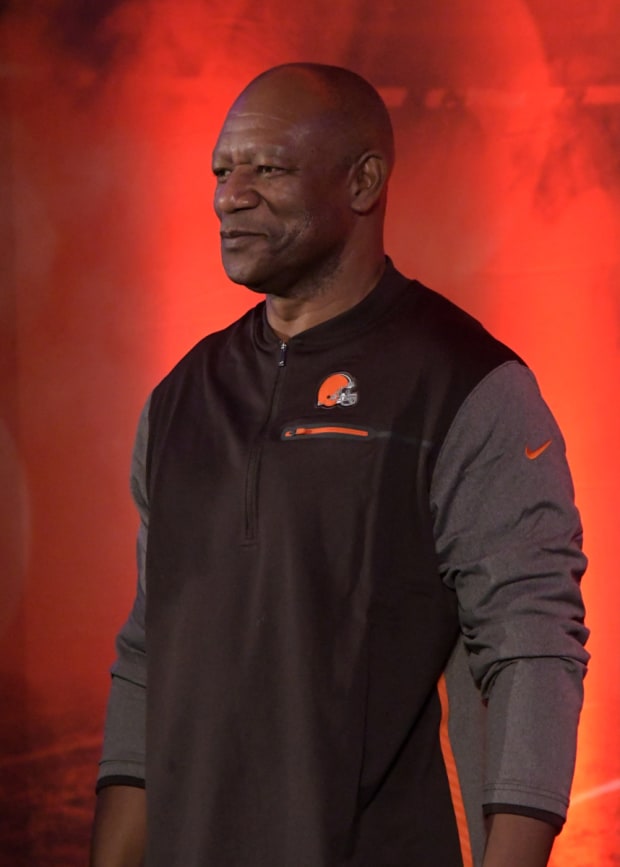
Former Browns cornerback Hanford Dixon speaks during NFL UK Live at the Landmark Hotel in 2017. Dixon is credited with inspiring the “Dawg Pound” section of fans.

5. Hanford Dixon

  • Seasons With Browns: 1981–89
  • Position: Cornerback
  • Playoff Appearances: 1982, 1985–89
  • All-Pro: 1986–87
  • Pro Bowl: 1986–88

As an elite cornerback from the time he was drafted in the first round of the 1981 NFL Draft, Hanford Dixon was invaluable to the Browns throughout the '80s.

Going into the 1984 season, Dixon had grown tired of mediocrity (Cleveland was 18–23 from 1981 to '83), so he encouraged the team's linebackers to be more aggressive in their pursuit of quarterback sacks. The result was another poor showing in the standings (5–11) but a great improvement on defense (No. 6 in the NFL in opponent scoring). A coaching change came in the middle of season, and the defensively minded Marty Schottenheimer would transform the Browns into a winner.

Dixon would later be known as the "Top Dawg," and the portion of the stands right behind one end zone at Cleveland's Municipal Stadium became known as the "Dawg Pound." That rowdy section remains in place at FirstEnergy Stadium and will forever be Dixon's lasting legacy with the Browns. Not that his play won't be remembered as well.

He had 26 interceptions in 131 games over nine seasons with the Browns, though that number was limited because quarterbacks tended not to throw to the receiver who Dixon was defending. The Browns opted not to retain Dixon after the 1989 season, leading him to accept an offer from the 49ers, but he was injured in the preseason and retired instead.

4. Bob Gain

  • Seasons With Browns: 1952, 1954–64
  • Position: Defensive lineman
  • Playoff Appearances: 1952, 1954–55, 1957–58, '64
  • All-Pro: 1958
  • Pro Bowl: 1957–59, 1961–62

Bob Gain left the University of Kentucky as a consensus All-American, but it wasn't until later seasons that he would see significant time in the NFL. Gain was drafted by the Packers in the first round of the 1951 NFL Draft, but he and the team could not come to terms on a contract, so he left for the Canadian Football League. After one successful season there, he returned to the NFL, where his rights had been traded to the Browns in an eight-player swap with Green Bay. He posted a strong rookie campaign to help Cleveland win the 1952 NFL championship, but then spent a year in the Air Force.

Gain returned to the NFL for the last two games of the 1954 season, then played in every game through '63. That streak would likely have continued had he not suffered a career-ending broken leg in 1964.

He primarily played on the left side of the defensive line, but was able to play every position along the line. In 126 games with the Browns, he recovered 15 fumbles and had one interception, which he returned 22 yards for a touchdown. Additionally, he was a perfect three for three on point-after touchdown kicks in 1952.
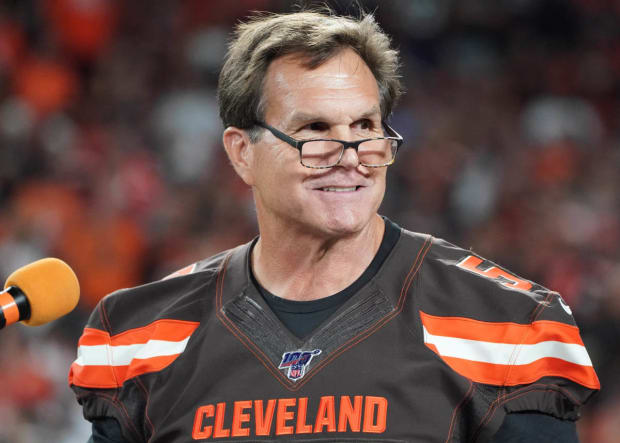
Former Browns linebacker Clay Matthews Jr. smiles while addressing the crowd in 2019 during his induction into the franchise’s Ring of Honor. He is the greatest linebacker in Browns history.

3. Clay Matthews Jr.

  • Seasons With Browns: 1978–93
  • Position: Linebacker
  • Playoff Appearances: 1980, '82, 1985–89
  • All-Pro: 1984
  • Pro Bowl: 1985, 1987–89
  • Awards: Browns Ring of Honor

No player in the history of the Browns has played in more games than Clay Matthews Jr., and that's not the only franchise record he holds. Matthews was a force as an outside linebacker for 16 seasons, making him

the best linebacker and one of the most popular players to ever play for Cleveland. He holds career records for sacks (62) and tackles (1,430), though neither stat was counted in the earliest days of the NFL. In fact, sacks weren't counted in the first five seasons of Matthews' career. As for tackles, Matthews had at least 100 in a season eight times.

Matthews was a critical member of the late 1980s defenses that helped push the Browns into the playoffs each year from '85 to '89, though none of those teams would appear in the Super Bowl. In the divisional round of the 1989 playoffs, Matthews made a critical interception against the Bills to secure a 34–30 victory. It was his only interception in 10 playoff games, but he did record two sacks in the postseason.

Matthews is a Hall of Fame hopeful—he's been named a semifinalist in voting by the Modern Era committee four times—and if elected, he and his brother Bruce would become the first set of brothers ever enshrined.

2. Len Ford

  • Seasons With Browns: 1950–57
  • Position: Defensive lineman
  • Playoff Appearances: 1950–55, '57
  • All-Pro: 1951–54
  • Pro Bowl: 1951–54
  • Awards: Hall of Fame (1976), NFL 1950s All-Decade Team

When Len Ford played in the AAFC, he could only watch as the Browns dominated the league. As a rookie tight end and defensive end for the Los Angeles Dons in 1948, Ford had no way of knowing he'd join those fearsome Browns just two seasons later.

The Dons were disbanded when the AAFC folded after the 1949 season, and the Browns selected Ford in the second round of the AAFC dispersal draft. With that pick, they found one of the best defensive linemen in franchise history. Even though Ford had shown strong receiving abilities with the Dons, the Browns already had so many offensive weapons that he was used exclusively on defense.

Ford helped revolutionize how players on the ends of a defensive line played, as he often rushed the quarterback from the outside instead of the inside. Ford's aggressive style helped him recover 19 fumbles in eight seasons with the Browns—including 14 during his peak playing years between 1951 and '54.

He was also a big reason why Cleveland won NFL titles in 1950, '54 and '55. That was especially true in the 1954 championship game, when he had two interceptions in a 56–10 win over the Lions. He also added an interception in the 1955 championship game—a 38–14 win against the Rams. In the regular season, Ford had just one interception in 88 games with the Browns.

1. Bill Willis

  • Seasons With Browns: 1946–53
  • Position: Defensive line
  • Playoff Appearances: 1946–53
  • All-AAFC: 1946–49
  • All-Pro: 1950–53
  • Pro Bowl: 1950–52
  • Awards: Hall of Fame (1977), Browns Ring of Honor, NFL 1940s All-Decade Team

Bill Willis anchored the defense for the Browns in their first eight seasons of existence. As such, he won five straight championships to open his career and appeared in the championship each of the next three seasons. During Willis' tenure, Cleveland's defense allowed the fewest points in the league six times and the second-fewest in the other two seasons. He helped the Browns finish as the only team in AAFC history to never give up more than 200 points in a season.

In 1950, the Browns weren't expected to be competitive in their first season in the NFL, but players like Willis helped them finish with a 10–2 record and a spot in a one-game playoff to see which American Conference team would advance to the NFL title game. In that matchup against the Giants, Willis made multiple defensive stops near the goal line as the Browns nursed a 3–0 lead, and he then was part of the contingent that tackled New York quarterback Charlie Conerly for a safety in the eventual 8–3 victory. Cleveland would go on to defeat the Rams a week later for the NFL title.

Just as important as his on-field contributions, however, was his place as one of the African American players to break football's modern-era color line in 1946. Willis and his teammate, fullback Marion Motley, were the only Black players in the league at the onset of the AAFC, and two players for the Rams broke the NFL's color barrier the same season. Both Willis and Motley overcame racism during their earliest seasons to become Hall of Fame players. Overall, Willis played 99 regular-season games for the Browns.

Honorable Mentions

With so many standout defensive players in the history of the Browns, there were numerous players right on the cusp of being included among the top 10. Listed below are several players who left an indelible mark on team history, but didn't quite make the cut.

Thom Darden (1972–81)

Thom Darden—the owner of the Browns' career interception record (45) and tied for the single-season interception record (10)—is remembered as one of the finest defensive backs in franchise history. Darden came to Cleveland as a first-round draft pick in 1972 and never played for another team.

He primarily played as a free safety and was selected to one Pro Bowl. That came in 1978, when he led the NFL with 10 interceptions, which he returned for an NFL-best 200 yards. His career total of yardage from interception returns (820 yards) is also a franchise record.

Jerry Sherk (1970–81)

Jerry Sherk opened his career with the Browns in front of a primetime audience and went on to become one of the best defensive linemen in franchise history. He debuted in the first Monday Night Football game in history, and for the next 12 seasons, Sherk was a mainstay for Cleveland's line, though he did struggle with injuries in his later seasons.

In 1975, he was voted the best defensive lineman in the NFL by the offensive linemen, winning the short-lived Bulldog Award. In 1976, he was a first-team All-Pro and won the Halas trophy for Defensive Player of the Year. He was also a four-time Pro Bowler. In his career, Sherk had 12 fumble recoveries and three interceptions.

Bill Glass (1962–68)

When the Browns and Lions made a six-player trade in 1962, Bill Glass was an afterthought in a headlining deal that saw the teams exchange quarterbacks. Glass, it turned out, would be the best player involved in the trade.

As a tenacious defensive end, Glass would make four Pro Bowls with Cleveland and help the Browns win the 1964 NFL championship. Sacks weren't counted as an official statistic while Glass played, but he was consistently pressuring the quarterback. Glass didn't miss a game with the Browns until a career-ending injury late in the 1968 season.

Clarence Scott (1971–83)

One of the most dependable players in Browns history was legendary defensive back Clarence Scott. During his 13-year career, the only game he missed came during his rookie season. Otherwise, he was there for Cleveland, both as a safety and a cornerback. He didn't earn a lot of accolades—he was named a Pro Bowler just once, in 1973—but he did intercept 39 passes and recover 11 fumbles during his career. He had at least two interceptions in every season of his career, except for his sophomore campaign.

Defensive Records for the Cleveland Browns

Defensive records for teams are difficult to track since some basic statistics of today's NFL (most notably tackles and sacks) weren't recorded by the NFL for several decades. Below are a handful of Browns defensive records which are contained in the NFL record book.

Cleveland Browns Defensive Records

  • Career Interceptions: 45, Thom Darden (1972–81)
  • Single-Season Interceptions: 10, Anthony Henry (2001) and Darden ('78)
  • Single-Game Interceptions: 3, 11 times (last was Anthony Henry on Nov. 18, 2001)
  • Longest Interception Return: 100 yards, Brodney Pool (Nov. 18, 2007)
  • Career Sacks*: 62, Clay Matthews Jr. (1978–93)
  • Single-Season Sacks*: 14, Reggie Camp (1984)
  • Single-Game Sacks*: 4, Andra Davis (Nov. 9, 2003)
  • Longest Fumble Return: 89 yards, Don Paul (Nov. 10, 1957)

*Sacks became an official statistic in 1982. Records here reflect only official statistics.

Wednesday, 11 November 2020

New on SI: Report: Kansas City Asks for NFL Inquiry into Unmasked NFLPA Union Rep

An unmasked NFLPA representative was reportedly mingling in close proximity with Chiefs players.

The Kansas City Chiefs reportedly asked the NFL to launch an inquiry with the players' association after an allegedly unmasked union representative held an in-person meeting with the team late last month,

sources told ESPN's Adam Schefter

The source said that the representative was mingling in close proximity with Chiefs players. 

"Concern is this is a violation of NFL-NFLPA protocols and the rep is not subject to same testing as players and personnel and regularly travels among clubs, per source," Schefter highlighted on Twitter. "NFL and team believes this created unnecessary risk of exposure to players and staff."

The Chiefs have placed multiple players on the NFL reserve/COVID-19 list throughout the season, most recently WR Mecole Hardman on Wednesday. 

Last week, defensive lineman Chris Jones was added to the list, but he was activated the next day, allowing him to play in Sunday's game against the Panthers. Fullback Anthony Sherman missed three games while on the COVID list but was activated on Nov. 4 before playing against the Panthers on Nov. 8. 

The Chiefs have a bye week before taking on the Raiders in Las Vegas during Week 11. 

Saturday, 7 November 2020

New on SI: Patriots-Jets Preview

EAST RUTHERFORD, N.J. (AP) Well, this is unusual.

The skidding New England Patriots and winless New York Jets square off Monday night in a once-spicy matchup of AFC East rivals dealing with big-time struggles.

The Jets' woes are nothing new, of course, but they're a loss away from the first 0-9 start in franchise history. Meanwhile, Bill Belichick's bunch is sputtering into MetLife Stadium on a four-game losing streak. And, that's just not normal.

''Nobody plans for a bad season, that's for sure,'' Patriots running back James White said. ''We're still competing. Everything we want is still out there in front of us. We just have to turn the sense of urgency up a lot more.''

That has usually not been a problem for New England under Belichick, whose teams have won 11 straight division titles - with Tom Brady at quarterback, of course. He's now in Tampa.

The Patriots currently sit in third place - yes, third! - at 2-5, two games behind Miami (4-3) and 3 1/2 behind AFC East-leading Buffalo (6-2).

Sure, there's time to turn things around, but a loss to the Jets in front of a prime-time TV audience would mark New England's first five-game losing streak since 1995, when it finished 6-10 under Bill Parcells.

''You're not going to get change by walking around here negative or walking around with your head down, declaring the season to be over,'' cornerback Jason McCourty said. ''The only way you're going to create change or try to make a difference or get yourself out of the situation you're in is to continue to work.

''I think if you're negatively working, that's the results you're going to get.''

Adam Gase's Jets know about negative results. New York is 0-8 for the first time since the 1996 team lost its first eight and finished 1-15 under Rich Kotite. That team is generally considered the worst in Jets history, but this year's squad could give that one a run - especially if they lose Monday night to make some dubious franchise history.

''Obviously everyone wants to win,'' quarterback Sam Darnold said. ''That's why we're in this business. That's why we're professional football players. We got here by winning football games. For us, we've just got to put our heads down and go back to work. I feel like if we do that, we can win this game and worry about the next when it's up.''

DOWN DARNOLD

Darnold will sit out the game after his throwing shoulder didn't feel right in practice Friday after reinjuring it last week at Kansas City. He and the Jets were optimistic earlier in the week that he'd play, but was listed as doubtful Saturday. Joe Flacco is expected to start in his place

That comes after Darnold initially sprained the AC joint in the arm and had to sit out two games. He struggled since his return, and thrown for just three touchdowns with six interceptions in six games this season. His 65.9 quarterback rating is last in the NFL among quarterbacks that have made at least three starts.

''When I talked to him, I see a guy that's, you know, he's young, but he understands kind of what this profession is,'' Gase said. ''It's about what can we do to change things, what can we do to fix things, what does he have to do, what do the rest of the guys have to do? He's trying to acquire that information to make sure that he understands like, `Where can I help change things?'''

SLOW STARTS

The Patriots entered the week ranked 29th in the NFL averaging 19.4 points per game. Part of the reason for their lack of production can be traced to their poor starts.

New England has scored just seven of its 136 total points this season in the first quarter, while giving up 36 points to opponents. It has created early deficits for an offense that has struggled to find a rhythm in the three games since quarterback Cam Newton returned from his stint on the reserve/COVID-19 list

''Yeah, we definitely want to change it and need to change,'' Belichick said. ''(Starting slowly) is not what we are trying to do, but we haven't done a very good job of it so far.''

THIRD-AND-UGH

One of the biggest culprits in the Jets' troubles on offense has been their inability to convert on third downs.

They went 2 for 12 in those situations and rank last in the NFL with a 28.30% conversion rate. In its last three games - including 2 of 8 against Buffalo, and 2 of 17 at Miami - New York has converted on third downs six times in 37 opportunities, a dismal 16.22%.

BALANCING INJURIES

Injuries have played havoc on the Patriots' ability to establish consistency on both sides of the ball. Knee injuries kept receiver Julian Edelman and star cornerback Stephon Gilmore out of last week's loss at Buffalo, along with receiver N'Keal Harry (concussion) and safety Kyle Dugger (ankle). Edelman and offensive lineman Justin Herron (ankle) were subsequently moved to injured reserve.

New England lost more players during the game, with defensive tackle Lawrence Guy leaving in the third quarter with a shoulder injury, and linebacker Ja'Whaun Bentley exiting in the fourth with a groin injury.

One bright spot: It has created opportunities for backup players such as running back Damien Harris and receiver Jakobi Meyers. Harris had his second 100-yard game of the season last week, and Meyers has 10 catches for 118 yards over the past two games.

-

AP Sports Writer Kyle Hightower contributed.

---

More AP NFL coverage: https://apnews.com/NFL and https://twitter.com/AP-NFL

Friday, 6 November 2020

New on SI: 49ers WR Kendrick Bourne Tests Negative for COVID-19, Clearing Way for Return

Kendrick Bourne tested negative again on Friday, a day after the NFL and NFLPA are reportedly investigating both the 49ers and the player.

SANTA CLARA, Calif. — After a week filled with bad news from injuries, a positive coronavirus test and a lopsided loss to Green Bay, the San Francisco 49ers finally got a piece of good news.

Receiver Kendrick Bourne tested negative for COVID-19 for a second straight day Friday, clearing the way for him and close contacts Brandon Aiyuk, Trent Williams and Deebo Samuel to return to the team.

Unfortunately for the 49ers it’s too late to help this week because San Francisco already played Thursday night and lost 34-17 to the Packers.

“I know it’s frustrating, but it is what it is,” coach Kyle Shanahan said Friday. “That’s what everyone in this world’s got to deal with right now. They’re doing that for the safety. Unfortunately, it wasn’t necessary, but I get why it did happen. So, got to deal with it and we obviously dealt with that last night. So, hopefully it won’t happen going forward.”

The Niners paid the price for the rules when they were forced to play without their two projected starting receivers for the game, Bourne and Aiyuk, as well as their starting left tackle in Williams. Samuel was already ruled out of the game with a hamstring injury.

Backup tackle Justin Skule allowed six pressures, according to Pro Football Focus, including one that led to an interception late in the first half that helped Green Bay open up a big lead.

Those absences were in addition to a run of injuries that sidelined quarterback Jimmy Garoppolo, 2019 All-Pro tight end George Kittle, leading rusher Raheem Mostert, as well as several key defensive players.

“That’s the most frustrating part, we know that we can be so much better,” backup quarterback Nick Mullens said. “Even with the guys that we had on the field, myself included. We really feel like we can be a lot better and so with these couple of days away, just regroup, reset, and just foot on the gas for these upcoming weeks.”

Tuesday, 3 November 2020

New on SI: Rodney McLeod and Eagles Teammates Ride Bus, Encourage Voters

Rodney McLeod and several of his teammates used megaphones to tell crowds the importance of voting and remind them to wear masks.

PHILADELPHIA — Philadelphia Eagles safety Rodney McLeod and several of his teammates rode on a double-decker bus and encouraged people to vote as they traveled throughout the city on Tuesday.

Using megaphones to address crowds along several routes, McLeod and his teammates emphasized the importance of voting and reminded everyone to wear masks to protect themselves from COVID-19.

“It has been amazing to see how excited and prideful everyone is about voting,” McLeod said. “When they see the bus and give us a thumbs-up that they voted, we are confident that change is going to come.”

Defensive backs Darius Slay, Jalen Mills, Avonte Maddox, Grayland Arnold and Elijah Riley, wide receiver Greg Ward, tight end Dallas Goedert, tackle Jordan Mailata and backup quarterback Jalen Hurts joined McLeod on the bus.

“Go out there and vote. Make your voice be heard,” Hurts shouted to the crowd.

McLeod and his wife, Erika, developed a “My Voice My Vote” initiative in partnership with their Change Our Future Foundation to support and encourage civic engagement and voting in the city. They provided free shuttle service to polling locations in North Philadelphia and provided meals to volunteer poll workers.

City officials joined the McLeods and the Eagles players on the bus and a DJ turned the ride into a party atmosphere.

“It drew a great reaction out of people. They were happy to see some of their favorite Eagles in the middle of the hood,” said Pastor Carl Day, a Cowboys fan who was along one of the bus stops. “I didn’t care to see him after he scored a TD against my team, but it was cool of them.”

McLeod returned a fumble 53 yards for a touchdown in Philadelphia’s 23-9 victory over Dallas on Sunday night. The Eagles (3-4-1) are first in the NFC East and have a bye this week.

Monday, 2 November 2020

New on SI: Best Head Coaches in Arizona Cardinals History

The Cardinals have had many head coaches throughout their 100-year history, and this article will explore the greatest leaders to ever roam the sidelines for the franchise.

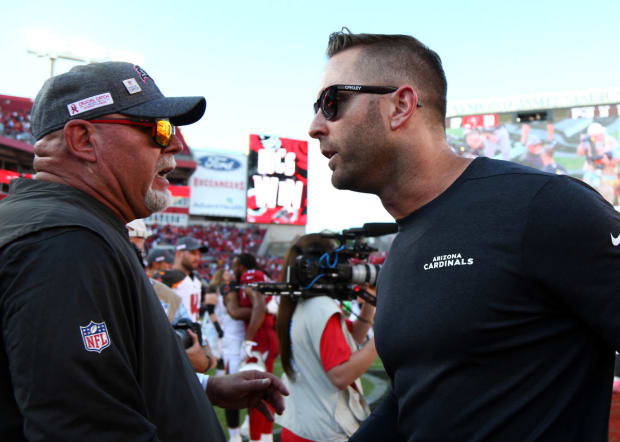
Buccaneers head coach Bruce Arians (left), who had a lengthy tenure with the Cardinals, greets Cardinals coach Kliff Kingsbury after a 2019 game.

Who Are the Greatest Head Coaches in Cardinals History?

The success or failure of an NFL franchise often rests on the shoulders of the team's head coach. The ultimate goal for any franchise's front office is to hire a head coach who can balance on-field and off-field responsibilities, and build a winning roster and playbook. The Cardinals have been in business for 100 years and have bounced around cities. They began as the Chicago Cardinals from 1920–59, then the St. Louis Cardinals from 1960–87, then the Phoenix Cardinals from 1988–93, and finally as the Arizona Cardinals since 1994. While their success has been limited, the team has hired several prominent head coaches.

The Cardinals won NFL championships in 1925 and '47, but playoff success was all but nonexistent again until the late 2000s. It was in 2008 that the Cardinals made the only Super Bowl appearance in franchise history, narrowly losing to the Steelers. In the mid-2010s, the Cardinals had another resurgence and had the greatest regular seasons in team history in both '14 and '15, and made the NFC championship game in '15. Naturally, the coaches from these great moments are among the best ever in franchise history.

Selection Criteria for This List

There were some difficult choices when it came to ranking the best head coaches in Cardinals history, as many of the top coaches have similar credentials. To help narrow things down, criteria used to make this list included:

  • Legacy Honors (Hall of Fame, Ring of Honor, etc.)
  • Coaching success (winning percentage, postseason appearances, etc.)
  • Longevity (years spent with the Cardinals)

Only games coached with the Cardinals are factored into this list, so while Hall of Famer Curly Lambeau won six championships with the Packers, his 7–15 mark over two seasons with the Cardinals won't make the cut here. Let's count down my picks for the five best head coaches in Cardinals history!

5. John (Paddy) Driscoll

  • Years Coached With the Cardinals: 1920–22
  • Record: 17-8-4
  • Legacy Honors: Cardinals Ring of Honor

In September of 1920, Driscoll signed with the Racine Cardinals, where he became head coach and quarterback. He lead the Cardinals through three successful seasons before focusing exclusively on being their quarterback.

In 1920, which is widely considered the inaugural season of the NFL, Driscoll became the first, first-team All-Pro quarterback, while leading the Cardinals to a 6-2-2 record and a fourth-place finish in the standings. After two more winning seasons, Driscoll surrendered coaching duties to his teammate, Arnie Horween. By helping establish the franchise as a contender, however, he put together the foundation that was needed for the Cardinals to claim the 1925 NFL championship.

Paddy Driscoll's Coaching Record With the Cardinals

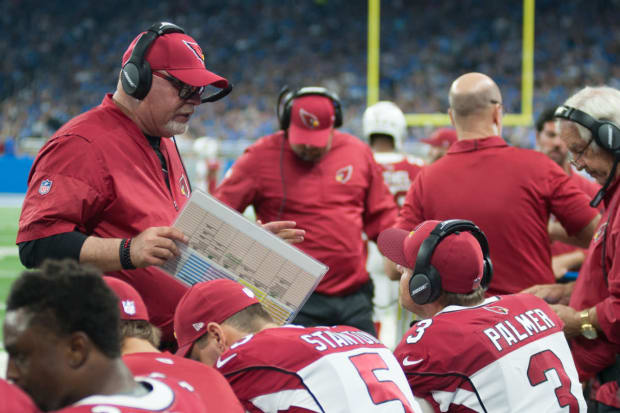
Former Cardinals head coach Bruce Arians talks to quarterback Carson Palmer (3), during a 2017 game against the Lions.

4. Bruce Arians

  • Years Coached With the Cardinals: 2013–17
  • Record: 49-30-1
  • Playoff Appearances: 2014–15
  • Awards: AP Head Coach of the Year (2014)

After a successful tenure as the interim head coach of the Colts in 2012, the Cardinals signed Bruce Arians to a four-year contract for the 2013 season. Arians became the most successful first-year head coach in team history and then led the Cardinals to the postseason the following two seasons. He was just 1–2 in the playoffs but holds the franchise record with 49 career victories.

In 2012, the Cardinals finished last in the NFL in total offense. Bringing in Arians to turn around that performance was an easy decision. Arians was a long-time offensive coordinator who won a Super Bowl while coaching for the Steelers. By his third season, Arizona gained more offensive yards than any team in the league and was No. 2 in scoring offense. The team's 13–3 mark that year established a new franchise record, but for the second season in a row, the Cardinals failed to win the conference championship. That was the third year in a row that Arians had led the Cardinals to at least 10 victories, and made him the fourth head coach in franchise history to post three straight winning seasons. However, in the two seasons that followed, the Cardinals toiled around the .500 mark, and Arians retired after the 2017 season—though he came out of retirement to join Tampa Bay in 2019.

Bruce Arians' Coaching Record With the Cardinals

3. Ken Whisenhunt

  • Years Coached With the Cardinals: 2007–12
  • Record: 45–51
  • Playoff Appearances: 2008–09

No one has coached more games for the Cardinals than Ken Whisenhunt—and he's also the only man to lead the Cardinals to the Super Bowl. Whisenhunt was at the helm for 96 games over six seasons with Arizona, and in 2008, led his team to Super Bowl XLIII. Though the Cardinals lost that game to the Steelers, the season is remembered as one of the best for the franchise. Arizona finished just 9–7 that season, sneaking into the playoffs as a division champion before reeling off three straight wins to claim the NFC championship. Whisenhunt finished his tenure with more victories than any other coach in franchise history (Bruce Arians surpassed him in 2017) and has coached more playoff games than anyone in team history (6).

The Cardinals gave Whisenhunt his first head coaching job. Whisenhunt had found success as an assistant coach, winning Super Bowl XL as Pittsburgh's offensive coordinator. Arizona hoped Whisenhunt would establish some success for the franchise, which had just one winning season since coming to Phoenix in 1988, and one playoff victory since winning the 1947 NFL championship. The Cardinals came into the 2007 season after back-to-back 5–11 finishes, and Whisenhunt immediately boosted the team to a .500 record.

After getting Arizona into the Super Bowl the next season, Whisenhunt engineered another division championship in 2009 but took a loss in the second round of the postseason. Whisenhunt was unable to push the Cardinals back over .500 in each of the next three seasons, and he was fired after the 2012 season.

Ken Whisenhunt's Coaching Record With the Cardinals

2. Jimmy Conzelman

  • Years Coached With the Cardinals: 1940–42, 1946–48
  • Record: 31-31-3
  • Playoff Appearances: 1947–48
  • Championships: 1947
  • Awards: Sporting News Coach of the Year (1947)
  • Legacy Honors: Hall of Fame (1964), Cardinals Ring of Honor

The last head coach to lead the Cardinals to a championship was Jimmy Conzelman, who led his Chicago squad to the 1947 NFL title in his second stint as the team's head coach. Sub-par performances marked his first three seasons, and his Cardinals mustered just eight wins in that span. After transitioning to the MLB as a front office executive for the Browns from 1943–45, the Cardinals convinced Conzelman to return for a second stint as head coach. That is when he would inherit the famed "Million-Dollar Backfield" and turned the Cardinals into a serious championship contender.

Conzelman built a bruising offense around Hall of Fame running back Charley Trippi, beating the Eagles 28–21 and claiming the 1947 NFL title. The next season, the Cardinals went 11–1 in the regular season but lost to the Eagles in the championship game. The 7–0 loss is known for being played in a severe snowstorm. In January 1949, Conzelman abruptly resigned to focus on a post-football career in advertising, despite having a year left on his contract. In his resignation letter, Conzelman cited family reasons as a primary driver of his decision. "Jim's resignation was accepted reluctantly," team president Ray C. Benningsen said, "accepted only out of respect to his desire to retire to a life which will not make such great demands on him physically." (Chamberlain, 1949).

Jimmy Conzelman's Coaching Record With the Cardinals

1. Don Coryell

  • Years Coached With the Cardinals: 1973–77
  • Record: 42-27-1
  • Playoff Appearances: 1974–75
  • Awards: AP NFL Coach of the Year (1974)

In the 24 years between the last postseason appearance for the Cardinals in 1948 and another head coaching vacancy for the 1973 season, the franchise had finished with a winning record just eight times and placed last in the division in five seasons. Change was desperately desired by owner Bill Bidwell, and change is what they got by hiring long-time San Diego State head coach, Don Coryell. As an offensive guru, Coryell revitalized the Cardinals, pushing them to three straight 10-win seasons from 1974–76, and a pair of postseason appearances. He repaired a dormant offense that ranked near the bottom of the league in 1971 and ‘72.

At San Diego State, Coryell built a reputation as a winner. When he was hired by the Cardinals, his former player Jeff Staggs was already in St. Louis. “I’m just tickled to death that he’s with the Cardinals,” Staggs said. “I decided to go to San Diego State College because I was so impressed with his honesty. And everything he promised me he fulfilled. He has the players’ best interests foremost in his mind. His approach to the game is so professional” (Meyers, 1973).

After the Cardinals struggled in Coryell's first season at the helm, he transformed them into a winner known as the "Cardiac Cardinals." St. Louis won at least 10 games each of the next three seasons but couldn't find a victory in the playoffs. Still, his offensive philosophy turned players such as quarterback Jim Hart, return man and receiver Mel Gray, running back Jim Otis and offensive lineman Dan Dierdorf, into superstars. Coryell and the franchise had a falling out after a .500 finish in 1977. He became the head coach of the Chargers in 1978 and led them to four postseason appearances. Despite all of his successes, Coryell has not been enshrined in the Hall of Fame.

Don Coryell's Coaching Record With the Cardinals

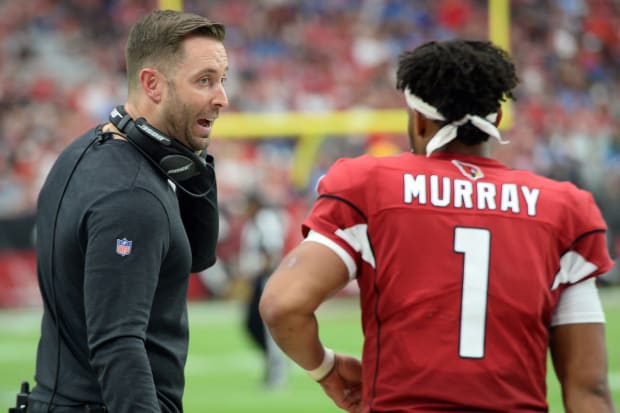
Arizona Cardinals head coach Kliff Kingsbury gives directions to rookie quarterback, Kyler Murray (1), in a 2019 game against the Lions. A former quarterback, Kingsbury has been entrusted to develop Murray into a star.

Honorable Mentions

The following head coaches left an indelible mark on Cardinals history, but didn't quite make the top five.

Jim Hanifan (1980–85)

Jim Hanifan is one of just three coaches in franchise history to coach for six seasons, but he only had one playoff appearance to show for it. That came in the strike-shortened 1982 season, but the Cardinals lost to the Packers in the opening round. His team went 8-7-1 the following season, and then just missed a playoff spot with a 9–7 mark in 1984. He was 39-49-1 overall, and those 89 games as head coach served as a franchise record until 2012.

Norman Barry (1925–26)

The architect of the first championship in Cardinals history was Norman Berry, who led Chicago to the best record in the NFL in 1925 (11-2-1). Berry posted a 16-8-2 record in two seasons. Following his career in the NFL, Barry became a lawyer, Illinois state senator and a judge.

Vince Tobin (1996–2000)

It was Vince Tobin who ended the franchise's 50-year drought without a playoff victory by knocking off the Cowboys in 1998. That was the only winning season of Tobin's tenure, however, he only put together a meager 28–43 record in 4 1/2 seasons.

How Many Head Coaches Have the Arizona Cardinals Had?

There have been 40 head coaches in the history of the Cardinals franchise, which has also played in Chicago, St. Louis, and Phoenix. There have been several seasons in team history when there were multiple co-coaches instead of one head coach.

Who Is the Current Head Coach of the Arizona Cardinals?

Kliff Kingsbury is currently the head coach of the Cardinals. He was hired on January 8, 2019, taking his first coaching job in the NFL after a lengthy tenure as the head coach of Texas Tech.

Arizona Cardinals Head Coach History

Works Cited

Chamberlain, C. "Jimmy Conzelman Quits as Cards' Grid Coach." The Decatur Herald. pp. 6. January 8, 1949. Retrieved from

Newspapers.com on March 3, 2020.

Meyers, J. “Coryell Promises Wide-Open Offense.” St. Louis Post-Dispatch. Pp. 1C-5C. January 19, 1973. Retrieved from Newspapers.com February 17, 2020.

Sunday, 1 November 2020

New on SI: Bears, Saints Brawl After Javon Wims Punches C.J. Gardner-Johnson

Bears wide receiver Javon Wims threw a couple punches that seemed to catch Saints defensive back C.J. Gardner-Johnson off-guard during Sunday's game.

Early in the third quarter of the Bears-Saints game, Bears wide receiver Javon Wims threw two punches at Saints defensive back C.J. Gardner-Johnson, leading to a brawl between both teams.

The fight occurred at the end of a play in which the action took place on the other side of the field. Wims was being guarded by Janoris Jenkins, and when the play stopped Wims jogged over to Gardner-Johnson and immediately threw a punch. Gardner-Johnson did not retaliate and appeared surprised before Wims punched him again with his right hand. Jenkins then intervened, followed by players from each side.

It's unclear what, if anything, happened between Wims and Gardner-Johnson that would have led to the bad blood. Wims was ejected from the game for his actions.

Gardner-Johnson was also the player who was reportedly punched by Saints teammate Michael Thomas during a practice in October.

New on SI: Report: Trent Brown Hospitalized After Pregame IV Mishap

Brown will reportedly stay overnight in a Cleveland hospital for further evaluation.

Raiders offensive tackle Trent Brown was hospitalized on Sunday after a "mishap" with his pregame IV, according to the NFL Network's

Ian Rapoport and Tom Pelissero

Brown was inactive for Las Vegas' win over the Browns on Sunday in Cleveland. He was taken out of the locker room in a wheelchair after air entered his bloodstream during the IV insertion, per Rapoport and Pelissero. Brown will reportedly stay in Cleveland overnight for additional tests. 

"We're just going to say that [Brown] got ill here in the locker room and he's being evaluated right now," Raiders head coach Jon Gruden said postgame. "We'll update you as soon as we something. But I'm told everything is OK. We were expecting Trent to play today, he had a great practice on Friday."

Brown was activated off the COVID-19 list on Friday. He has played just two games in 2020, most recently appearing in Las Vegas' win over the Chiefs on Oct. 11. The Oklahoma product signed a four-year, $66 million contract with the Raiders in 2019.

Las Vegas was able to control the line of scrimmage for much of Sunday's contest despite Brown's absence. The Raiders rushed for 208 yards in their 16-6 victory, holding possession for nearly 38 minutes.

The Raiders sit second in the AFC West at 4–3 following Sunday's victory. They will face the Chargers on Nov. 8, with kickoff slated for 4:05 p.m. ET. 

Friday, 30 October 2020

New on SI: 10 Best Pittsburgh Steelers Defensive Players of All Time

These are the top 10 Pittsburgh Steelers defensive players of all time. The Steelers have always been known for tough defense and these are the men that built that reputation.

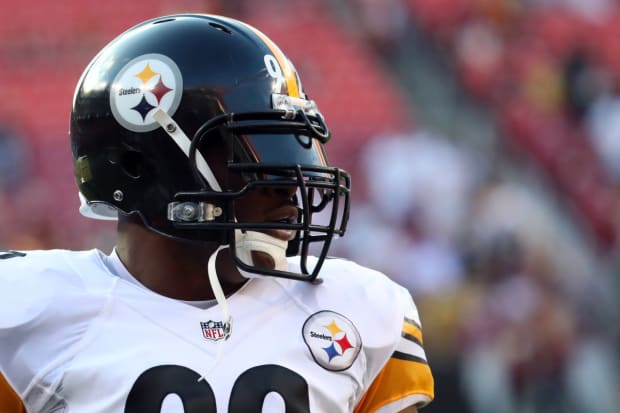
Linebacker James Harrison is one of the best defensive players in Steelers' history.

There are two ways to win a football game: score more points than your opponent or prevent them from scoring more points than you. For the last fifty years, the Steelers have excelled at the latter.

During the ‘70s, the Steelers' Steel Curtain defense was a 4–3 scheme with a dominant front four, three athletic linebackers and hard-hitting defensive backs. The ‘90s ushered in the Blitzburgh era, marked by hyper-aggressive linebackers who relentlessly ran down quarterbacks. During the Super Bowl years of the mid-2000s, the addition of a roving, tenacious, strong safety made the Steelers defense even more dangerous.

The Steelers defense has ranked in the top five for points allowed in a season 17 times since 1972. During that same period, Pittsburgh has won six Super Bowls and eight AFC championships. Even during the pre-Super Bowl era, when the Steelers rarely posted a winning season, they still fielded powerful defenses. In 1957, the Steelers ranked first in the NFL for yards allowed and second for points allowed.

Choosing the Top Defenders in Steelers History

The players on this list are the best Steelers defensive players of all time. They made the cut based on:

  • their dominance during the time in which they played,
  • stats and accolades,
  • contributions to championships,
  • and overall value to the Steelers organization.

Ultimately, these players on this list are not only the greatest defensive players in Steeler franchise history but also some of the best the NFL has ever seen.

10. Jack Butler

Defensive Back, 1951–59

Today, Jack Butler is somewhat of an unsung hero from pre-Super-Bowl-era Steelers lore. While it is true that the franchise struggled through most of its early history, there were bright spots and a few superstars, and Butler was one of them.

In nine seasons, he intercepted an impressive 52 passes and took four of them back for touchdowns. He ranks second in franchise history for career interceptions, behind only Mel Blount. He made four Pro Bowls and three All-Pro teams even though the Steelers could only put together two winning seasons during Butler’s tenure.

Butler finally joined other great

Steelers in the Hall of Fame when he was enshrined with the class of 2012, more than 50 years after his retirement from the NFL. He is an all-time Steelers great from a time when greatness was hard to come by.

Jersey Number: 80

Accolades

  • 4 Pro Bowls
  • 3 All-Pro Selections
  • Hall of Fame Class of 2012

Stats

  • 9 Seasons
  • 104 Games
  • 52 Interceptions for 827 Yards and 4 Touchdowns
  • 10 Fumble Recoveries for 38 Yards and 1 Touchdown

9. Kevin Greene

Linebacker, 1993–95

It is tough to decide where Kevin Greene should rank among the best Steelers defensive players. He is a Hall of Famer and one of the top linebackers of all time, a pass-rushing machine with a nonstop motor. He played opposite fellow outside linebacker Greg Lloyd in an aggressive 3–4 defense, and the pair pummeled quarterbacks for three amazing seasons in Pittsburgh. Greene’s time in the Steel City culminated in a trip to Super Bowl XXX, an achievement he played no small part in.

On the other hand, he only spent three seasons in Pittsburgh before moving on to the Panthers after the Super Bowl season of 1995. For that reason alone, it seems unfair to rank him higher than other Steelers greats who spent all or most of their careers in the black and gold. Greene is one of those players that Steeler Nation sure would have liked to have stuck around longer.

Jersey Number: 91

Accolades

  • 2 Pro Bowls
  • 1 All-Pro Selection
  • Hall of Fame Class of 2016

Stats

  • 3 Seasons
  • 48 Games
  • 35.5 Sacks
  • 1 Interception
  • 6 Fumble Recoveries

8. Ernie Stautner

Defensive Tackle, 1950–63

Like Jack Butler, Ernie Stautner was a Hall-of-Fame-caliber defensive player during an era when the Steelers rarely posted a winning season. Undersized at only 230 pounds, he made up for it with toughness and tenacity. Thanks to his gritty style of play, Stautner and players like him began to cultivate the reputation for tough, hard-hitting defensive football that the Steelers are still known for today.

Stautner made the Pro Bowl roster nine times and the All-Pro team once in his 14-year career. In 1964, the Steelers retired his No. 70 jersey. For a long time, he was the only player in Steeler franchise history to have his jersey retired by the franchise, though Joe Greene joined him in that honor in 2014. Ernie Stautner was enshrined in the Hall of Fame with the class of 1969.

Jersey Number: 70

Accolades

  • 9 Pro Bowls
  • 1 All-Pro Selection
  • Hall of Fame Class of 1969

Stats

  • 14 Seasons
  • 173 Games
  • 2 Interceptions
  • 23 Fumble Recoveries
  • 3 Safeties

7. Mel Blount

Cornerback, 1970–83

Mel Blount was one of the toughest cornerbacks of his era. At 6’3” tall, he towered over most wide receivers and his physical playing style fit in perfectly with Pittsburgh's Steel Curtain defense. Blount’s aggressive abuse of receivers eventually led to a rule change and today, defensive backs are no longer allowed to contact receivers more than five yards beyond the line of scrimmage.

Blount played 200 games as a Steeler, intercepted 57 passes and made five Pro Bowls and two All-Pro teams. In 1975, he earned the award for NFL Defensive Player of the Year, and throughout the ‘70s, he helped the Steelers win four Super Bowls. Blount was enshrined in the Hall of Fame with the class of 1989.

Jersey Number: 47

Accolades

  • 5 Pro Bowls
  • 2 All-Pro Selections
  • 4 Super Bowl Championships
  • 1975 Defensive Player of the Year
  • Hall of Fame Class of 1989

Stats

  • 14 Seasons
  • 200 Games
  • 57 Interceptions for 736 Yards and 2 Touchdowns
  • 13 Fumble Recoveries, 2 Touchdowns
James Harrison (92) is the Steelers' All-Time sack leader.

6. James Harrison

Linebacker, 2002, 2004–12, 2014–2017

Linebacker James Harrison chased down quarterbacks for 14 seasons with the Steelers. He is the franchise’s all-time leading pass rusher with 80.5 sacks, and he played a major role in two Super Bowl championships. He made five Pro Bowls and two All-Pro teams during 177 games as a Steeler and he was named NFL Defensive Player of the Year in 2008. Harrison's 100-yard interception return in Super Bowl XLIII helped solidify one of the biggest wins in Steelers' history.

Harrison took the long road to NFL stardom and struggled to make the roster with both the Steelers and Ravens as a young player. He spent some time with the Rhein Fire of NFL Europe before returning to the Steelers and eventually becoming a full-time starter in 2007. The rest is history, as Harrison went on to become one of the most dangerous pass rushers in the NFL and a major problem for any offensive coordinator that faced the Steelers.

Jersey Number: 92

Accolades

  • 5 Pro Bowls
  • 2 All-Pro Selections
  • 2 Super Bowl Championships
  • 2008 Defensive Player of the Year

Stats

  • 14 Seasons
  • 177 Games
  • 80.5 Sacks
  • 7 Interceptions for 86 Yards
  • 8 Fumble Recoveries

5. Rod Woodson

Cornerback, 1987–96

Woodson was a cornerback and return man with blazing speed. Drafted by the Steelers in 1987, he made his first of six straight Pro Bowls in 1989. In 10 seasons as a Steeler, he made a total of seven Pro Bowls and was voted an All-Pro five times. He intercepted 38 passes and returned five for touchdowns. Woodson was awarded the Defensive Player of the Year in 1993.

As a return man, Woodson ran back two kicks and two punts for scores during his time with the Steelers. He was a star player during a time when the Steelers had few and a scoring threat any time he got his hands on the ball. Because of Woodson and other players in the early ‘90s, the Steelers were able to return to their former glory and make the playoffs under new head coach Bill Cowher. Woodson missed the 1995 regular season with a knee injury but still managed to play in the Super Bowl that year. Woodson was inducted into the Hall of Fame in 2009.

Jersey Number: 26

Accolades

  • 7 Pro Bowls
  • 5 All-Pro Selections
  • 1993 Defensive Player of the Year
  • Hall of Fame Class of 2009

Stats

  • Seasons 10
  • 134 Games
  • 38 Interceptions for 779 Yards and 5 Touchdowns
  • 21 Fumbles Recovered for 1 Touchdown
  • 257 Punt Returns for 2,362 Yards and 2 Touchdowns
  • 220 Kick Returns for 4,894 Yards and 2 Touchdowns

4. Jack Ham

Linebacker, 1971–82

Jack Ham was not only the best outside linebacker ever to put on a Steelers uniform, but he was also one of the best in NFL history. He came to the Steelers in 1971 as part of a draft class that included safety Mike Wagner and defensive tackle Ernie Holmes, two more defensive stars who, along with Ham, were part of the Steelers dynasty of the '70s.

Ham made eight straight Pro Bowls and six straight All-Pro teams in his 12 seasons with the Steelers. He was an excellent all-around athlete with the strength to handle blockers, the speed to cover running backs and the intelligence to make the right decisions. He was enshrined in the Hall of Fame with the class of 1988.

Jersey Number: 59

Accolades

  • 8 Pro Bowls
  • 6 All-Pro Selections
  • 4 Super Bowl Championships
  • Hall of Fame Class of 1988

Stats

  • 12 Seasons
  • 162 Games
  • 32 Interceptions for 218 yards and 1 Touchdown
  • 21 Fumble Recoveries for 1 Touchdown
  • 3 Sacks
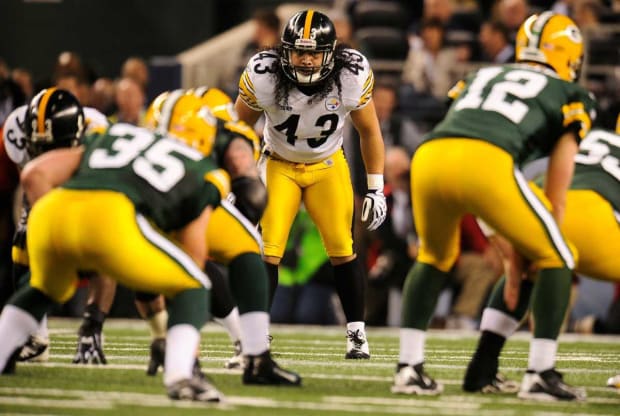
Troy Polamalu (43) is one of the best defensive players in Steelers history.

3. Troy Polamalu

Safety, 2003–14

As a Steelers fan, it is fun to imagine how much sleep offensive coordinators must have lost during the nights before facing Troy Polamalu and the Pittsburgh defense. While the Pittsburgh pass rush and run defense were highly ranked in the mid-2000s, Troy Polamalu was the heart and soul of the defense.

Polamalu was an unpredictable terror with the freedom to make made bold decisions that offenses often didn’t expect. In his prime, he seemed to be everywhere at once and there was little an opposing quarterback could do to avoid him. During 12 seasons, he helped the Steelers win two Super Bowls and three AFC championships. He made eight Pro Bowls and four All-Pro teams and was named Defensive Player of the Year in 2010. He intercepted 32 passes, recovered seven fumbles, and in 158 games, he scored five defensive touchdowns.

Jersey Number: 43

Accolades

  • 8 Pro Bowls
  • 4 All-Pro Selections
  • 2010 Defensive Player of the Year
  • 2 Super Bowl Championships

Stats

  • 12 Seasons
  • 158 Games
  • 32 Interceptions for 398 Yards and 3 Touchdowns
  • 7 Fumbles Recovered for 2 Touchdowns
  • 12 Sacks

2. Jack Lambert

Linebacker, 1974–84

As a rookie, Jack Lambert filled in at middle linebacker when starter Henry Davis got injured. Davis never got his job back. Lambert earned Defensive Rookie of the Year in 1974, and Defensive Player of the Year in 1976. Throughout 11 seasons, he made nine Pro Bowls and six All-Pro teams.

Lambert was a terrifying presence with missing front teeth and a perpetual scowl on his face. He wore huge shoulder pads with a neck roll, and at 6’4”, he loomed over quarterbacks before the snap like a dark, menacing storm cloud. In reality, he was an undersized linebacker even for his era. Though listed at 220 pounds, according to some accounts, he was much lighter.

It didn’t matter. Lambert was ferocious on the field and seemed to treat every play like a street fight. He set the tone for an unforgiving Pittsburgh defense that won four Super Bowl championships for the Steelers. Today he is regarded as one of the best middle linebackers ever to play the game.

Lambert was enshrined in the Hall of Fame with the class of 1990.

Jersey Number: 58

Accolades

  • 9 Pro Bowls
  • 6 All-Pro Selections
  • 1974 Defensive Rookie of the Year
  • 1976 Defensive Player of the Year
  • 4 Super Bowl Championships
  • Hall of Fame Class of 1990

Stats

  • 11 Seasons
  • 146 Games
  • 28 Interceptions for 243 Yards
  • 17 Fumble Recoveries
  • 8 Sacks

1. Joe Greene

Defensive Tackle, 1969–81

Though it might be hard to imagine today, the years before the arrival of head coach Chuck Noll in 1969 were dark days for the Steelers. With the exception of a few years here and there, for the better part of four decades, the Steelers were rarely able to cobble together a winning season.

In 1969, Noll drafted a defensive tackle named Joe Greene, and the tide began to turn. Greene was named Defensive Rookie of the Year in 1969, and the Steelers continued to draft well over the next few years. By 1972, the Steelers had their first winning season since 1963 and defeated the Raiders for the franchise’s first-ever playoff win. In 1974, the Pittsburgh Steelers won the Super Bowl.

The Steelers won three more Super Bowls during the 1970s and are widely considered the Team of the Decade. Today, Pittsburgh is one of the most successful NFL franchises in history. It all started with Joe Greene.

“Mean” Joe Greene played for 13 seasons in Pittsburgh. He was named NFL Defensive Player of the Year in 1972 and '74, and he made an amazing 10 Pro Bowls and four All-Pro teams. Greene was enshrined in the Hall of Fame in 1987. In 2014, he joined Ernie Stautner as one of two Steelers to ever have their jersey numbers officially retired by the organization.

Jersey Number: 75

Accolades

  • 10 Pro Bowls
  • 4 All-Pro Selections
  • 1969 Defensive Rookie of the Year
  • 1972 Defensive Player of the Year
  • 1974 Defensive Player of the Year
  • 4 Super Bowl Championships
  • Hall of Fame Class of 1987

Stats

  • 13 Seasons
  • 181 Games
  • 1 Interception for 26 Yards
  • 1 Fumble Recovery

Who Is the Best Steelers Defensive Player of All Time?

Joe Greene is the greatest Steelers player of all time and is regarded as one of the best defensive tackles ever to play in the NFL. He made more Pro Bowls than any other Steeler in history and earned Defensive Player of the Year twice. He was a hard-nosed player who didn’t tolerate losing and set the tone for the Steel Curtain defense.

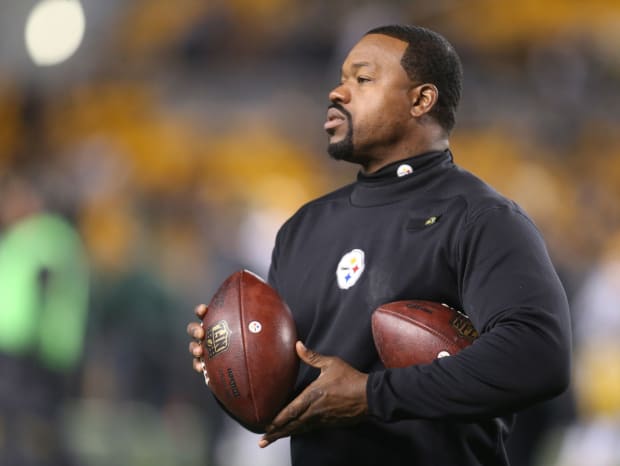
Joey Porter, former player and linebackers coach for the Steelers, was a hard-charging linebacker who played with a ton of heart.

Honorable Mentions

L.C. Greenwood

Defensive End, 1969–81

Greenwood arrived in Pittsburgh with the 1969 draft—the same year as Joe Greene. The pair lined up alongside each other from 1969 to '81 and made up half of the original Steel Curtain defensive line. Greenwood made six Pro Bowls and two All-Pro rosters. Many Steelers fans believe he deserves to be in the Hall of Fame.

Donnie Shell

Safety, 1974–87

Shell is an old-school Steeler who was finally inducted into the Hall of Fame in 2020. He helped win four Super Bowls and intercepted 51 passes in his 14-year career. He made the Pro Bowl five times and All-Pro three times.

Greg Lloyd

Linebacker, 1988–97

Lloyd was an intimidating linebacker with a bad on-field attitude who would have fit in perfectly with the Steelers of the 1970s. He made five Pro Bowls and three All-Pro teams as a Steeler and racked up a total of 53.5 sacks. Lloyd helped the Steelers make it back to the Super Bowl in 1995 where they lost to the Cowboys.

Jason Gildon

Linebacker, 1994–2003

Gildon’s 77 career sacks rank him second behind James Harrison in franchise history. He was a prototypical Steelers pass rusher who made three Pro Bowls and one All-Pro team during his time in Pittsburgh.

Carnell Lake

Defensive Back, 1989–98

Lake was a linebacker in college who became a Pro-Bowl safety in the NFL. He had an All-Pro season at cornerback as well when Steelers cornerback Rod Woodson left and Coach Bill Cowher asked Lake to fill in. During his time in Pittsburgh, Lake made the Pro Bowl four times and All-Pro once.

Joey Porter

Linebacker, 1999–2006

Porter was an aggressive pass rusher who tallied 60 sacks during his eight years as a Steeler, putting him third in team history. He made three Pro Bowls and one All-Pro roster as Steeler and helped Pittsburgh win a Super Bowl in 2005.

Steelers All-Time Sacks Leaders

Pittsburgh Steelers Defensive Records

Interceptions All-Time

Mel Blount (1970-1983): 57

Interceptions in a Season

Mel Blount (1975): 11

Sacks All-Time

James Harrison (2002–17): 80.5

Sacks in a Season

James Harrison (2008): 16

Safeties All-Time

Ernie Stautner (1950–63): 3

Bill McPeak (1949–57): 3

Steelers All-Time Interception Leaders

What Was the Steel Curtain?

Most Steelers fans have heard about the Steel Curtain defense. It has become a term practically synonymous with Pittsburgh football, but it is occasionally misused and misunderstood. The era of the Steel Curtain was a specific time period in the 1970s, and while it is poetic to use the term for modern Steelers defenses, it really isn't accurate.

The Steel Curtain often is used to refer to the entire Steelers defense of the '70s Super Bowl period, a definition that is acceptable in the eyes of most Steelers fans. However, Steelers sticklers will tell you the term Steel Curtain refers only to the front four defensive linemen.

Who Were the Original Steel Curtain?

  • L.C. Greenwood: Defensive End
  • Joe Greene: Defensive Tackle
  • Ernie Holmes: Defensive Tackle
  • Dwight White: Defensive End

These four players teamed up from 1971 to '77, making for one of the greatest defensive lines in NFL history. Holmes left the team in '77 and was replaced by defensive tackles John Banaszak, Gary Dunn and Steve Furness for the final two Super Bowls championships of the era.

Top-Ranked Steelers Defenses

Defense Wins Championships

They say that defense wins championships, but this may no longer be true in the modern NFL. I'm not convinced an NFL team can win a Super Bowl today without a great quarterback and a powerful offense. Even the best defenses struggle to contain the top-level, high-scoring offenses in the modern-era NFL.

But if you do happen to have a great quarterback and an offense capable of putting four touchdowns on the board every game, a strong defense can still make a big difference. Games in today's NFL are often battles of attrition, and stopping your opponent from scoring more points than you is still a valid game plan.

The Steelers of the '70s stopped offenses in their tracks with a tenacious front four called the Steel Curtain. Blitzburgh of the '90s relentlessly chased down quarterbacks. The Steelers defense of the mid-2000s confused opponents with a ferocious pass rush and an unpredictable All-Pro strong safety.

The Steelers of today still play great defense . . . maybe even championship caliber. But without an offense that can put points on the board, they may never achieve what their predecessors had.

Time will tell. The NFL is always changing, and defenses today have more to worry about than any other time in the history of the league.

Stats and Reference

Wednesday, 28 October 2020

New on SI: Bucs Coach Bruce Arians: Antonio Brown 'Fantastic' in First Team Workout

Arians was impressed with Brown's first workout since signing with Tampa Bay. Brown is eligible to play in Week 9 after his personal conduct suspension expires.

Following his team's risky decision to sign wide receiver Antonio Brown, Buccaneers coach Bruce Arians said Brown "looked fantastic" in his first workout with Tampa Bay,

per ESPN's Jenna Laine.

"He looks fantastic. I think we had really good conversations today, he and I," Arians said Wednesday. "He was in the meetings and everything. And he's working with Anthony Piroli and the strength staff. He looks in great shape. Yeah, ready to go next week."

Brown's eight-game suspension for violating the league's personal conduct policy ends after this week, making him eligible to play in the Bucs' home game on Nov. 8 against the Saints.

Arians's decision to sign Brown raised some eyebrows around the league after the coach had previously said such a pairing would not happen back in March. Then, Arians shot down the idea that the Bucs would sign Brown, saying, "I just know him, and it's not a fit in our locker room." In January 2019, Arians said Brown had "too much diva" going on during an appearance on ESPN NFL insider Adam Schefter's podcast.

A key factor in the team reversing its course is Brown's relationship with quarterback Tom Brady. Brady, who was briefly teammates with Brown in New England, was asked by Laine to expand upon his relationship with Brown, and why the six-time Super Bowl champion has actively vouched on his behalf.

"Over the years, when you transition from a younger player to an older player, you really want to see guys succeed and you want to see guys do well. It’s always about maximizing your potential," Brady said. "I had a lot of people support me over the years, realizing that I was far from where I needed to be, and they would guide me and provide me with the help I needed as a player to reach my potential. And I think that's how you impact people. We talk about it a lot as professional athletes—how you impact people on the field is one thing, how you impact people off the field is another...

"You just try your best everyday, realizing that a lot of people weren’t born with the same advantages that I had growing up. They weren’t born with the same background, the same support systems that I had. I think when you recognize that, and you bring that to relationships, all you can do is the best you can do...I want to see other guys succeed, and a lot of joy in my experience comes from seeing other people be their best, and seeing people succeed in ways that can set their family up."

Brown, 32, has been accused of sexual assault by multiple women since September 2019. He pled no contest to charges related to his moving truck driver battery case earlier this year. Brown appeared in one game with the Patriots in 2019 before being released on Sept. 20.

Tuesday, 27 October 2020

New on SI: The Best Wide Receivers in Los Angeles Rams Franchise History

The Rams have rolled out several legendary wide receivers over the course of the franchise's history. In this article, I count down the Rams' top five wide receivers of all time.

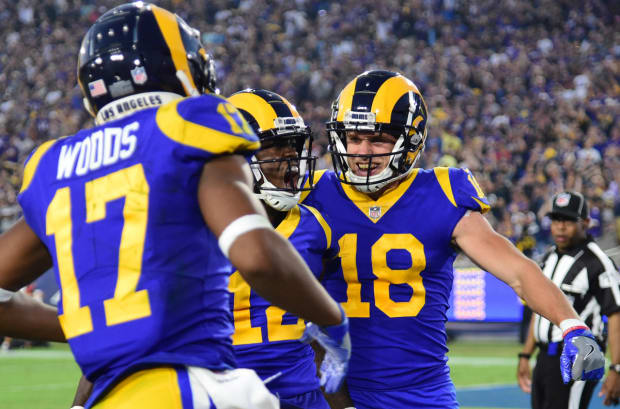
Los Angeles Rams wide receiver Robert Woods (17) celebrates with fellow receivers Cooper Kupp (18) and Brandin Cooks (12) after catching a touchdown pass in the third quarter against the Minnesota Vikings in 2018.

Who Are the Greatest Wide Receivers in Rams History?

The Rams have had numerous superstar wide receivers over the years, but there are five who stand out above the rest. With 36 individual 1,000-yard seasons in franchise history, the Rams’ top receivers cover some of the finest years the team has seen. Selecting the greatest receiver in franchise history was an especially daunting task, as a pair of players from the same era were both strong contenders for the No. 1 selection.

Three wide receivers who played primarily for the Rams have been inducted into the Hall of Fame, and two more players who are prominent in franchise history have the potential to be inducted soon. Those players comprise the top five on this list, but trying to rank them was quite the challenge. So who did I determine is the greatest wide receiver in the history of the Rams? Read on to find out!

Selection Criteria

  • Legacy Honors (Hall of Fame, retired number, etc.)
  • Single-Season Honors (MVP, All-Pro, Pro Bowl, etc.)
  • On-Field Success (league leader, playoff appearances, records, etc.)
  • Longevity (years with the Rams, percentage of career with the Rams, etc.)

Only games played with the Rams are factored into this list, so while legendary slot receiver Wes Welker would be a great player to include on a list about the Patriots, his 102 yards over eight games with the Rams won't make the cut here. For the purposes of this article, players established as tight ends will be excluded, but those who played as an end in the 1940s, '50s and '60s were given consideration. Let's count down the top five receivers in Rams history! Feel free to chime in with your thoughts on these selections.

5. Henry Ellard

  • Years With the Rams: 1983–93
  • Playoff Appearances: 1983–86, '88, '89
  • All-Pro: 1984, '88
  • Pro Bowl: 1984, '88, '89

Henry Ellard had a record-setting year as a senior at Fresno State, which propelled him to the Rams as a second-round pick in the 1983 NFL Draft. The Rams walked away from the first two rounds of that draft with a pair of players who were vital to the team's success over the rest of the decade—the other being Hall of Fame running back Eric Dickerson. That duo would lead the Rams into the postseason as rookies, and Ellard would ultimately make six playoff appearances for Los Angeles on his way to setting numerous team records.

The Rams were confident that Ellard had good enough hands to contribute as a receiver right away, and he did just that with 91 yards on three catches in his professional debut. He contributed mostly as a punt returner in his early years, however, and he ran back four touchdowns over the first three seasons of his career. His first Pro Bowl and All-Pro selections were as a punt returner in 1984 after he led the league with two touchdowns and a long return of 83 yards.

Ellard broke out as a receiver in 1988, when he led the league with a career-high 1,414 yards in what was the first of four straight seasons with at least 1,000 yards. Twice that season, he eclipsed 160 yards in a game, but his finest performance in a Rams uniform came in Week 2 of the 1989 season. In a win over the Colts, Ellard had career-bests when he hauled in 12 passes for 230 yards and three touchdowns. His best playoff showing came in January of 1990, when he caught eight passes for 125 yards against the Giants in a second-round victory.

After leaving the Rams, Ellard had several more successful seasons with Washington. In 11 seasons with Los Angeles, Ellard had 593 catches for 9,761 yards and 48 touchdowns. He is ranked 15th in NFL history with 13,777 yards, but he is not in the Hall of Fame, though he was nominated in 2019.

Henry Ellard's Statistics With the Rams

Rams Hall of Fame wide receiver Tom Fears is pictured on a 1955 Bowman football card.

4. Tom Fears

  • Years With the Rams: 1948–56
  • Playoff Appearances: 1949–52, '55
  • All-Pro: 1950
  • Pro Bowl: 1950
  • Major Awards: Hall of Fame (1970), NFL 1950s All-Decade Team

Tom Fears was such a good receiver during his career with the Rams that it's surprising that he was a converted defensive back. Fears was drafted out of Santa Clara University in the 11th round of the 1945 NFL Draft and became one of the all-time draft steals by turning into a Hall of Fame receiver. He didn't join the Rams until 1948, instead opting to play at UCLA in 1946 and '47.

But when Fears joined the NFL, he made an immediate contribution by leading the league with 51 receptions as a rookie, and it only got better from there. The next season, in 1949, Fears set a new NFL standard with 77 catches and led the league with nine touchdowns. In 1950, Fears broke his own receptions mark (setting a new NFL record) when he hauled in 84 passes—including a career-best, 18-catch, 189-yard game against the Packers. Fears had more than 1,000 receiving yards in each of those two seasons, and he helped the Rams to the NFL championship game both years.

Perhaps the finest moment of his career came in 1951 when he caught a 73-yard touchdown pass to break a 17–17 tie against the Browns in the NFL Championship game. That would prove to be the game-winning score in the franchise's first NFL title since their move to Los Angeles in 1946. Eventually, injuries began to take their toll on Fears, who retired in the middle of the 1956 season and only played one full campaign from '53 to '56.

Over the course of his nine-year career with the Rams, Fears caught 400 passes for 5,397 yards and 38 touchdowns. Following retirement, he remained with Los Angeles as an assistant coach, and he was involved with football in some capacity until the mid-1970s. In 1970, he became the first player of Mexican descent to make the Hall of Fame.

Tom Fears' Statistics With the Rams

Rams Hall of Fame wide receiver, Elroy "Crazy Legs" Hirsch, is pictured on a 1951 Bowman football card.

3. Elroy (Crazy Legs) Hirsch

  • Years With the Rams: 1949–57
  • Playoff Appearances: 1949–52, '55
  • All-Pro: 1951, '53
  • Pro Bowl: 1951–53
  • Major Awards: Hall of Fame (1968), NFL 1950s All-Decade Team, NFL 100 All-Time Team (2019)

Elroy (Crazy Legs) Hirsch was originally drafted by the Rams in 1945, but he ended up playing for the Rockets of the rival AAFC from '46 to '48. After his AAFC contract expired, Hirsch signed with the Rams, who had by then relocated from Cleveland to Los Angeles. Hirsch proved to be a versatile player for the Rams, but it wasn't until 1951 that he really showed the scope of his capabilities.

Hirsch set since-broken NFL records with 1,495 yards and 17 touchdowns that season, leading the Rams to their first league championship victory since moving to Los Angeles. He was a major threat that season, hauling in a 91-yard touchdown pass and averaging better than 50 yards on each of his touchdowns. In the season opener, he caught nine passes for 173 yards and four touchdowns. This set the stage for an outstanding campaign that saw him post at least 100 yards in nine of 12 regular-season games. He caught 66 yards in the NFL championship game.

Hirsch led the NFL in yards per reception in 1952, gaining 23.6 yards per catch. In 1953, Hirsch again showed he could stretch the field despite an unusual running style that gave him the nickname "Crazy Legs." During a win over the Packers, he caught nine passes for a career-high 196 yards, giving him a single game with at least 190 receiving yards for a third straight season. After retiring in 1957 with 343 receptions for 6,299 yards and 53 touchdowns, Hirsch became the Rams' general manager in 1960. In that role, he was responsible for drafting multiple Hall of Famers and remained in the front office until 1969.

Elroy (Crazy Legs) Hirsch's Statistics With the Rams

Rams receiver Torry Holt looks for space after making a catch. He caught more than 90 passes in a season six times.

2. Torry Holt

  • Years With the Rams: 1999–2008
  • Playoff Appearances: 1999–2001, '03, '04
  • All-Pro: 2003
  • Pro Bowl: 2000–01, 2003–07
  • Major Awards: NFL All-Rookie Team (1999)

As the sixth pick in the 1999 NFL Draft, Torry Holt produced right from the start, giving the Rams a tremendous return on their investment. His efforts as a rookie helped the team win Super Bowl XXXIV, and he continued on to become one of the league's premier receivers throughout the next decade. As time went on, however, the Rams lost several superstars and fell toward the bottom of the league standings, and Holt eventually requested his release.

After a standout season as a rookie, he would gain at least 1,300 yards in each of the next six seasons to set a since-broken NFL record. Holt led the league in receiving in 2000 and '03, the two seasons he eclipsed 1,600 yards. His 117 catches and 1,696 yards from '03 are the second-best marks in franchise history. Holt holds six of the top eight single-season reception totals in team history, as well as six of the top 12 single-season receiving yardage totals. He also hit 10,000 receiving yards in just 116 games (12 games shy of the NFL record). Holt failed to catch a pass in only one game of his Rams career during Week 5 of his rookie season.

The best individual showing of Holt's career came against the Colts in the 15th game of the 2001 season, when he hauled in seven passes for 203 yards and two touchdowns. He also had 200 yards in a 2003 loss to the 49ers. Holt had at least 10 receptions in a game 11 times and gained 100 yards in all but one of them. In 46 games with the Rams, Holt racked up at least 100 yards in a game, and he scored at least twice in 10 games. His career-high of three touchdowns came against the Seahawks in 2006. In 10 postseason games, Holt had 47 receptions for 630 yards and four touchdowns—including the first score in the second half of Super Bowl XXXIV.

Holt sits second in franchise history with 869 career receptions for 12,660 yards and 74 touchdowns. He advanced to the semifinals of voting by the Hall of Fame's Modern Era Committee in 2019. In NFL history, he is 16th in career receiving yardage, 21st in receptions and tied for 37th in receiving touchdowns.

Torry Holt's Statistics With the Rams

1. Isaac Bruce

  • Years With the Rams: 1994–2007
  • Playoff Appearances: 1999–2001, '03, '04
  • Pro Bowl: 1996, 1999–2001
  • Major Awards: Hall of Fame (2020), Rams No. 80 retired

When Isaac Bruce came to the Rams as a second-round draft pick in 1994, it began a long marriage between the two that resulted in the greatest wide receiver in franchise history. Bruce opened his career with a 34-yard touchdown reception and didn't quit until he owned nearly every major receiving record in team history. Fiercely competitive but also stoic, Bruce was a reliable target who racked up at least 1,000 yards in a season eight times in 14 seasons with the Rams. But more importantly, he served as the team's emotional and on-field leader for much of his career. His efforts were cemented in NFL history on Aug. 8, 2020, when he was inducted into the Hall of Fame in Canton, Ohio.

Bruce's second season in the league was his best. It came after the Rams moved from Los Angeles to St. Louis, and Bruce treated the new fans to a 119-catch, 1,781-yard, 13-touchdown season that helped establish him as one of the best receivers in the NFL. All but his touchdown tally remain franchise records. He led the league in receiving yardage in 1996 but was then slowed by injuries in '97 and '98. Bruce had a game with at least 200 yards each season from 1995 to '97, with 233 yards against the Falcons in '97, 229 yards against the Ravens in '96 and 210 yards against the Dolphins in '95. The Rams, however, were losers in each of those matchups.

From 1999 to 2001, Bruce was one of the catalysts for "The Greatest Show on Turf" teams that advanced to a pair of Super Bowls. He didn't miss a start in that stretch and accumulated 3,742 yards and 27 touchdowns. Bruce was on the receiving end of the go-ahead, 73-yard touchdown in Super Bowl XXXIV against the Titans. That helped give him a team-high 317 yards in the 1999 postseason. In 2000, he and teammate Torry Holt each caught more than 1,400 yards to become just the second set of teammates to do so. In 2001, he earned a third straight Pro Bowl selection by helping the Rams return to the Super Bowl (which they would lose to the Patriots).

Bruce played six more seasons for the Rams, posting at least 500 yards in each of them. After the 2007 season, Bruce was released due to a contract issue. During his tenure with the team, Bruce caught 942 passes for 14,109 yards and 84 touchdowns, which all stand as franchise records.

After leaving the Rams, he spent two years with the 49ers and caught his 1,000th career reception against his former team in 2008. He was traded back to St. Louis in June 2010 as a formality that allowed him to retire as a member of the Rams, who then retired his jersey (No. 80) during the 2010 season. At the time of his retirement, Bruce ranked third in NFL history in career receiving yardage (now fifth), seventh in receptions (now 13th), and seventh in receiving touchdowns (now 12th).

Isaac Bruce's Statistics With the Rams

Rams wide receiver Cooper Kupp runs upfield during the second quarter of a 2019 game against the Bengals during the NFL International Series at Wembley Stadium in London.

Honorable Mentions

With several standout wide receivers in the history of the Rams, I've decided to include a handful of players who also left an indelible mark on team history but didn't quite make the top five.

Jack Snow (1965–75)

As a rookie, Jack Snow broke into the starting lineup for the Rams, and in the next nine years, he only missed one start. In 1967, he led the NFL with an average of 26.3 yards per reception, and his 859 yards in 1970 marked his career-high. Snow's best game came in 1967, when he caught three passes for 151 yards and two touchdowns of 53 yards and 80 yards in a 24–24 tie against the Baltimore Colts. He later had three touchdowns in a 1969 win over the Saints. In an 11-year career, Snow caught 340 passes for 6,012 yards and 45 touchdowns.

Flipper Anderson (1988–94)

Flipper Anderson is best known for holding the NFL's all-time record for single-game receiving yardage. On Nov. 26, 1989, Anderson hauled in 15 catches for an astounding 336 yards and a touchdown in a 20–17 victory against the Saints. But Anderson was far from a one-game wonder. He led the league in yards per reception in 1989 and '90 while piling up over 1,000 yards in both seasons. Anderson also caught the game-winning touchdown in overtime against the Giants in a 1989 postseason matchup. During seven seasons with the Rams, Anderson caught 259 passes for 5,246 yards and 26 touchdowns.

Jim Benton (1938–47)

Another Rams receiver known primarily for a single game is James (Jim) Benton, who caught 10 passes for a then-NFL record 303 yards against the Lions on Thanksgiving in 1945. That performance helped push Benton to the only 1,000-yard season of his career and the first of two straight seasons in which he led the NFL in receiving yardage. Benton made the 1939 Pro Bowl, was a two-time first-team All-Pro selection ('45 and '46) and was named to the NFL 1940s All-Decade Team. In eight seasons with the Rams, Benton hauled in 275 passes for 4,566 yards and 42 touchdowns.

Cooper Kupp (2017–present)

Emerging as one of the best young receivers in the NFL, Cooper Kupp is one of the driving forces behind the resurgence of the Rams. As a rookie in 2017, Kupp was a vital cog in the offense and caught 869 yards. He was on his way to bettering that mark in 2018 before a torn ACL ended his season after eight games, while his teammates went all the way to the Super Bowl. In 2019, he eclipsed the 1,000-yard mark for the first time (1,161 yards on 94 catches). Thus far in his career, Kupp has caught 196 passes for 2,596 yards and 21 touchdowns.

Rams wide receiver Robert Woods (17) is all smiles after scoring a seven-yard touchdown in the first quarter against the Chiefs in 2018. He gained more than 1,000 yards that season.

Los Angeles Rams Wide Receiver History

It’s been said that to determine the greatest receiver in Rams history, you could flip a coin with Isaac Bruce on one side and Torry Holt on the other and not be wrong. Both players were special talents who should be in the Hall of Fame, and together, they created one of the most dynamic duos in modern NFL history. In general, the consensus is that Holt was the more talented player, but Bruce had the better career.

Bruce was also instrumental in helping the Rams go from a 4–12 team his rookie year to Super Bowl champions five seasons later. Between this and his statistics, Bruce has garnered more post-career attention than Holt. Bruce's jersey number was retired by the franchise, and after four times as a finalist in Hall of Fame voting, he was finally elected with the Class of 2020.

Holt, meanwhile, did more in less time statistically but stepped right onto a team that was already loaded with talent. He has yet to be formally honored by the franchise with a retired number, but he did reach the semifinals in voting by the Hall of Fame's Modern Era Committee in 2019.

The debate about who is better will certainly rage on for years, but in the meantime, let's look at some other receivers who should be remembered. The following is a list of franchise receiving records and individual statistics for every 1,000-yard receiving season in the Rams history.

Rams Receiving Records

  • Career Yards: 14,109, Isaac Bruce (1994–2007)
  • Single-Season Yards: 1,781, Isaac Bruce (1995)
  • Single-Game Yards: 336, Flipper Anderson (1989)*
  • Career Touchdowns: 84, Isaac Bruce (1994–2007)
  • Single-Season Touchdowns: 17, Elroy Hirsch (1951)
  • Single-Game Touchdowns: 4, Isaac Bruce (1999), Roy Green ('83), Harold Jackson ('73), Dave Williams ('69), Elroy Hirsch ('51)
  • Career Receptions: 942, Isaac Bruce (1994–2007)
  • Single-Season Receptions: 119, Isaac Bruce ('95)
  • Single-Game Receptions: 18, Tom Fears (December 3, 1950)

*NFL record

Rams wide receiver Kenny Britt (18) takes the field prior to a game against the Miami Dolphins in 2016. Britt gained more than 1,000 receiving yards on the season.

Rams Receivers With 1,000 Yards in a Season